Insurance can have additional packages:
- Cancer protection: +100 USD
- Family pack: +150 USD
If a person buys car insurance for 50 USD, they get an additional 10% discount. Employees who ordered the insurance previously but missed payments cannot be reinsured.
2. Equivalence partitioning
3. Boundary value analysis
4. Error guessing
5. Pairwise testing
1. Decision table
So, I used main program with basic and estimated cost and additional packages with their separate cost. Taking into account all the costs, I have the final total cost.
- Y means the condition is true,
- N means the condition is false,
- N/A means the value of the condition doesn’t matter,
- the cells also contain meaningful text.
- Y means the action should occur,
- N means the action should not occur,
- the cells also contain meaningful text.
What will be the result for exactly 5 years of work?
It is not clearly clear from the task condition.
What is the technical boundary in the code for possible employee experience?
This is not clearly specified in the task, but the condition is stated in such a way that there are no instructions for discounts on additional packages.
Calculations are made with the assumption that all discounts are considered only relative to the basic cost of the program and do not effect on additional packages' cost.
However, this issue needs to be clarified further in the requirements and/or from the PO, the customer.
each year
reinsured?
Final total cost of life insurance for an employee =
+ 100 USD
+ 150 USD
+ 100 USD
+ 150 USD
+ 100 USD
+ 150 USD
+ 100 USD + 150 USD
2. Domain testing
We can divide the entire category of work experience into equivalence classes to select a date from them.
Equivalence classes for work experience (E):
line: 0 - 5 - 10 - 20 - more years.
More accurate equivalence classes for work experience (E):
1) 0 > E (invalid class)
2) 0 < E < 5 years (What will be the result for exactly 5 years of work? It is not clearly clear from the task condition.)
3) 5 < E <= 10 years
4) 10 < E < 20 years
5) 20 < = E < = more years (open boundary). Additionally, I must ask the developers what technical boundary is set in the code for the possible experience of employees.
Every valid classes from 2 to 5 has four rules in table 1 (further - T1).
We also have other equivalence classes that match the conditions in the decision table:
- smokers are non-smokers
- owners of insurance for a car for $ 50 and not owners
- insured people who have previously made late payments on insurance and paid on time
- holders of various additional insurance packages
If the rule's conditions are binary, a single test for each combination is probably sufficient. On the other hand, if a condition is a range of values, consider testing at both the low and high end of the range. In this way we merge the ideas of Boundary Value testing with Decision Table testing.
In this situation choosing test cases is slightly more complex— each rule (vertical column) becomes a test case but values satisfying the conditions must be chosen.
Years are not an indivisible unit.
It is not known exactly how this function will be implemented. For example, it can be the selection of values (radio buttons or other), or the input of a number, or the data is processed automatically and transmitted to the system on request in the exact designation of the number of years and days.
The following options for treating the length of work experience can be selected:
- in years only in integers as indivisible units, e.g. 0, 1, 2, etc. years
- days worked also will be taken into account, e.g. 5 years and 1 day
- years are expressed in decimals, e.g. 4.99 years.
If we measure work experience exclusively in years as an indivisible value, then it may turn out that an employee who works for example for 6 months has 0 years of work experience. If we perceive a year as a divisible value, then the work experience is 0.5 years (or an equal number of days).
1) -1 year (invalid value, work experience cannot be expressed in negative numbers);
2) 0 years (valid), 4 years, 5 years (the reaction of the system is not known now);
3) 6 year; 9 years; 10 years;
4) 11 years; 19 years;
5) 20 years; 21 years; 60 years (approximate logical boundary).
Test cases: 1 (1st class - invalid) + 4 Rules T1 * 3 boundary values (2st class) + 4 Rules T1 * 3 boundary values (3st class) + 4 Rules T1 * 2 boundary values (4st class) + 4 Rules T1 * 3 boundary values (5st class) = 45
1) -1 day (invalid value, work experience cannot be expressed in negative numbers); 0 days (invalid value, because employees have the right to this insurance, and the employee will have at least 1 day of work experience);
2) 1 day; 5 years minus 1 day; 5 years exactly (the reaction of the system is not known now);
3) 5 years plus 1 day; 10 years minus 1 day; 10 years exactly;
4) 10 years plus 1 day; 20 years minus 1 day;
5) 20 years exactly; 20 years plus 1 day; 60 years exactly (approximate logical boundary).
Test cases: 2 (1st class - invalid) + 4 Rules T1 * 3 boundary values (2st class) + 4 Rules T1 * 3 boundary values (3st class) + 4 Rules T1 * 2 boundary values (4st class) + 4 Rules T1 * 3 boundary values (5st class) = 46
1) -0.01 years; 0.00 years (invalid class);
2) 0.01 years; 4.99 years; 5.00 years (the reaction of the system is not known now);
3) 5.01 years; 9.99 years; 10.00 years;
4) 10.01 years; 19.99 years;
5) 20.00 years; 20.01 years; 60.00 (approximate logical boundary).
Test cases: 2 (1st class - invalid) + 4 Rules T1 * 3 boundary values (2st class) + 4 Rules T1 * 3 boundary values (3st class) + 4 Rules T1 * 2 boundary values (4st class) + 4 Rules T1 * 3 boundary values (5st class) = 46
- decision table 1: 46
- decision table 2: 9
Situations with possible errors, defects, and failures:
- Integration with other modules.
- Determination the date for calculating insurance cost.
- What will happen if the inputs are not in the expected format.
- How the system will react to any changes in the parameters related to the employee to calculate the cost of insurance (will the date for calculation be chosen correctly, will it determine which value to choose correctly):
If the employee resigned and came back after some time, how will the system handle it?
If the employee has changed the status of smoking?
If the status of the owner of the car insurance has changed?
If an employee has made a late payment, how will it be reflected in the system, how will it handle this situation to solve the reinsurance rule?
If the employee has the main insurance and one additional one, and then decides to buy another additional one. Will the system calculate the cost correctly? Will there be an excessive calculation of the cost here?
only as a check of the decision table)
But it is not always correct to use it for complex business rules.
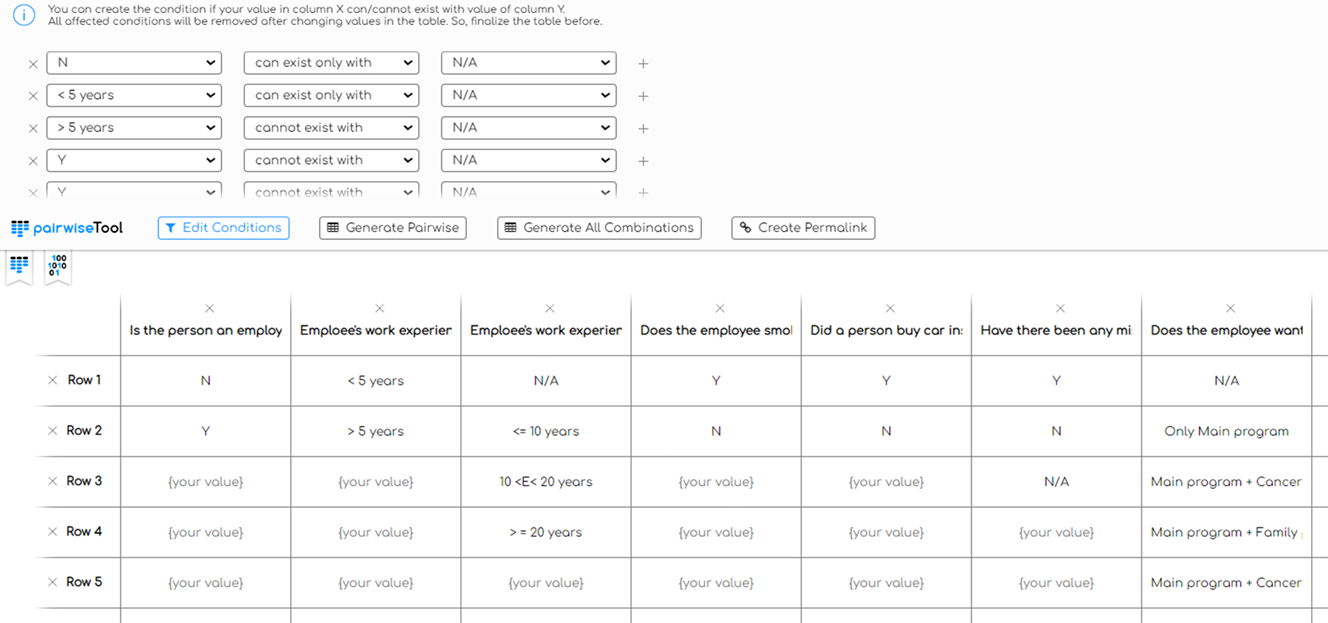
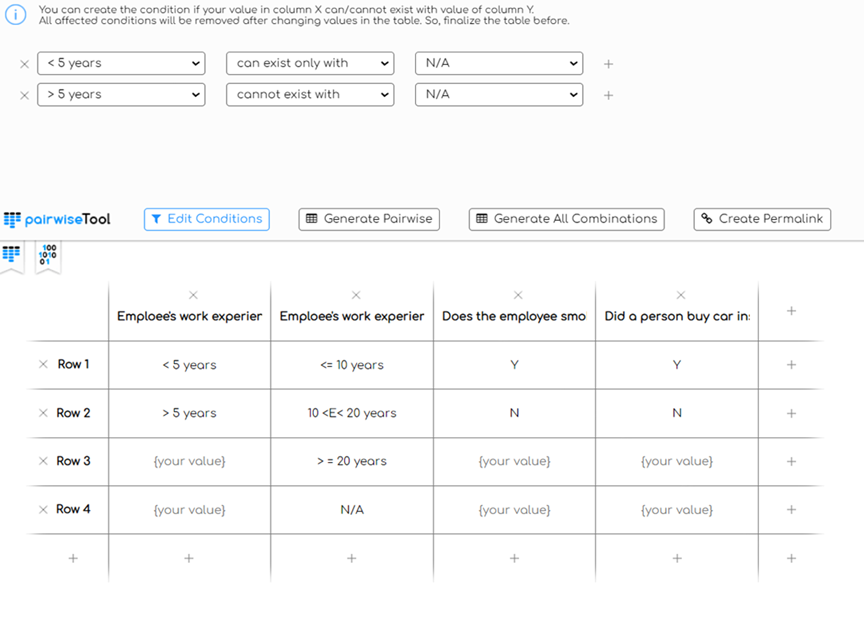
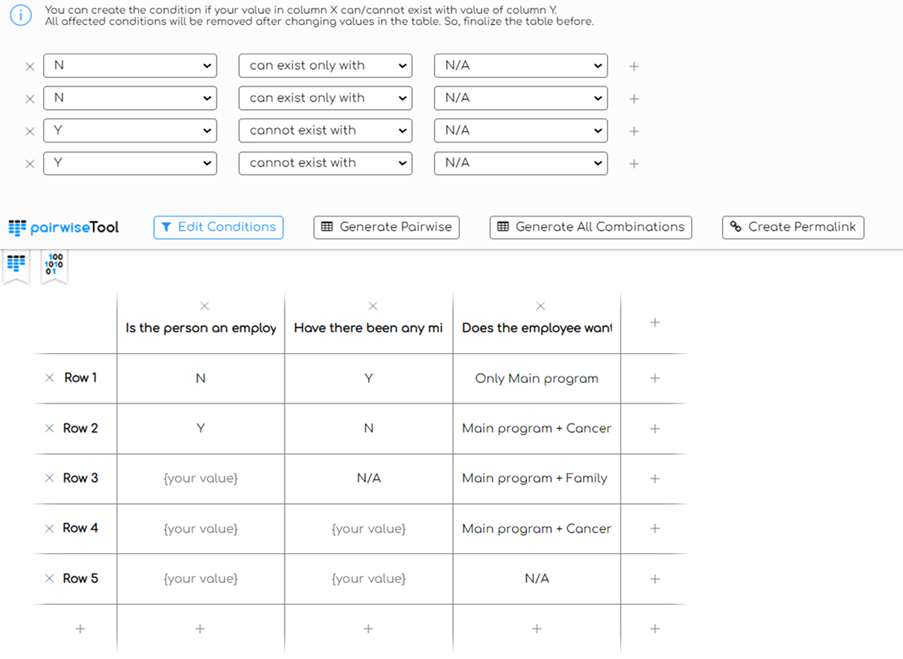
The choice between decision table and pairwise testing for testing the cost of insurance with multiple parameters depends on the testing goals, complexity of parameter interactions, and available resources. If the goal is to identify all possible combinations of parameters that can affect the insurance cost, decision table is a better choice. If the goal is to quickly and efficiently identify errors with minimal tests, pairwise testing is a better choice.
So the decision table should be chosen, because it is important for us to check whether the system performs actions correctly, and the table gives more clarity than pairwise testing.
In this case, pairwise testing will not provide adequate coverage.
I can find files with generated report in achieve.
Also I have several screenshots.
+ 1 test for not employees